
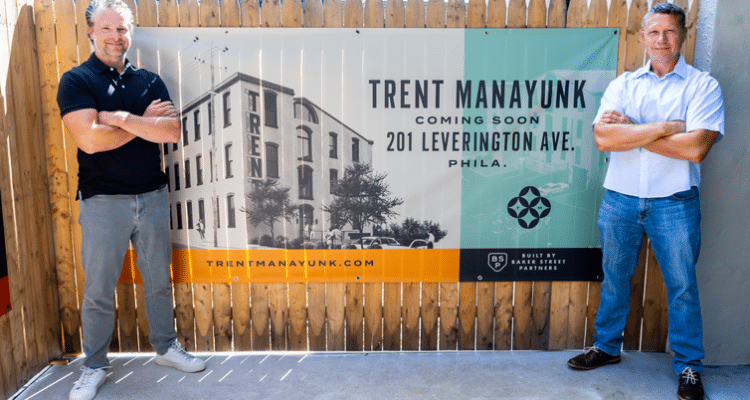
By Ben Logue • Photos by Big Ts House of Photos
For decades, the Trent Electrical Heating Element Company was part of Manayunk’s industrial rhythm. Its fortress-like building on Leverington Avenue with stone walls, chain link fencing, coils of barbed wire, and windows sealed behind metal cages, was a daily reminder of the neighborhood’s manufacturing roots. Employees passed through the gates each morning and neighbors walked past its unwelcoming facade on a daily basis. Even while the factory remained active, it projected the feeling of a shuttered institution, a holdover from a different era.
Today, the same structure glows with new life. Warm light spills from restored windows and residents stroll landscaped courtyards. On a block that once felt closed-off and foreboding, the building now serves as a beacon of renewal. The transformation is the work of Baker St Partners, led by lifelong Manayunk residents Steve Olszewski and Andy Mulson, who grew up in the shadow of the Trent building and refused to see it as a relic of the past.
A Neighborhood Connection Decades in the Making
For Olszewski and Mulson, The Trent was never just another factory. It was a landmark woven into the backdrop of their childhoods, part of the daily scenery of the neighborhood. Over the years, they had heard stories from friends’ parents and grandparents who had spent their entire careers inside its stone walls.
That personal connection lingered as they built their careers in real estate. When either Steve or Andy ran into neighbors who worked at Trent they would ask about the factory’s future. Eventually, when the company prepared to sell, a mutual friend bridged the conversation that made a purchase possible. In June 2023, Baker St Partners officially acquired the site.
From the start, the developers knew this project could not be treated like a blank slate. The building carried the weight of generations of labor, and any new chapter has to acknowledge that legacy.
Preserving the Industrial Soul
The first time Olszewski and Mulson walked through the cavernous factory floor as owners, they weren’t overwhelmed by the peeling paint of uneven floors. Instead, they counted windows, traced potential hallways, and sketched imaginary apartment layouts in their minds. Their background in adaptive reuse meant they could see through the dust to the potential.
That early vision never wavered. Today, phase one of The Trent offers 42 apartments ranging from 600 to 900 square feet. Units rent from $1,700 to $2,500 depending on size and character, but what makes the project special is not the square footage, it is the way the building’s story remains visible in every detail.
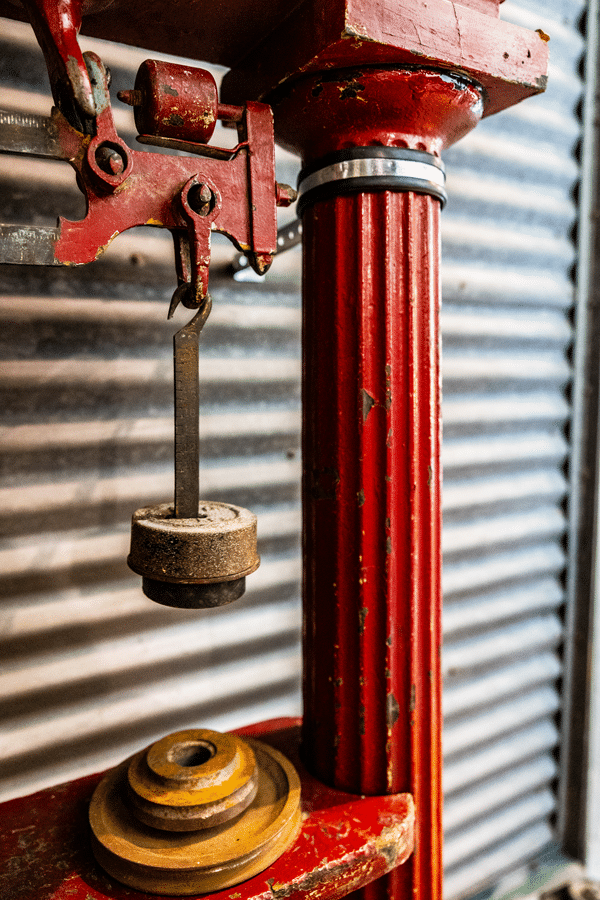
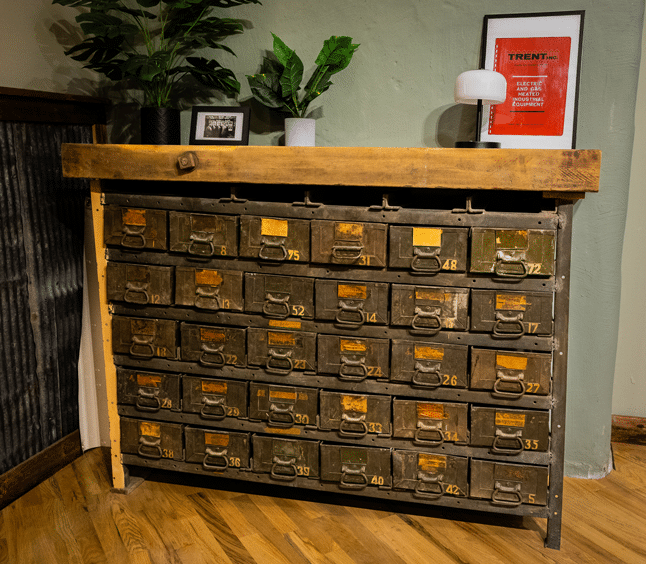
Rather than strip the structure to its bones and start fresh, Baker St leaned into the industrial heritage. Heavy timbers, steel beans, and even original factory equipment were salvaged and reimagined as architectural accents. The green hues that coated machinery and walls for decades became the foundation for the project’s interior palette.
The process of peeling back layers of the building revealed more than just construction techniques, it revealed time itself. Beneath the surface finishes, stonework from the 1800s emerged, a reminder that this building had already lived multiple lives before Trent called it home.
When construction reached a turning point, Baker St invited former employees back to walk the halls. More than 20 people came, some returning for the first time in decades. They pointed out where old workstations once stood, touched machines now displayed as art pieces, and shared stories. One woman, in her eighties, recalled clocking in during the 1960s. For her, the tour wasn’t just nostalgia, it was validation that the years she spent inside the factory were not forgotten.
This commitment to honoring the past extends to the building’s official status. The developers pursued National Historic Register designation, ensuring permanent preservation and adding another layer of historical significance to Leverington Avenue’s collection of restored mills and factories.
The Engineering Feat Behind the Beauty
Adapting a 140-year-old industrial building for modern living is not simple. The structure had been built for durability, not precision. Heavy timbers sagged after decades of use. Floors and walls learned from more than a century of settling. Each unit had to be carefully adapted to these quirks, making no two apartments exactly alike.
Major interventions were unavoidable. Steel reinforcements stabilized compromised beams. An entire basement column line was removed to create parking circulation. Cutting an elevator shaft through a dense frame requires carefully redistributing loads into new footings. Every decision demanded creativity and respect for the original construction.
Even with those challenges, Baker St kept the project on track by anticipating problems and budgeting conservatively. Their philosophy was to respect the building’s past, but engineer it for another hundred years of life.
A Different Kind of Amenity
In an era when new developments tout rooftop pools and boutique gyms, Trent takes a different approach. Olszewski and Milson believe Manayunk itself already provides the best amenities: miles of towpath, Pretzel Park, nearby gyms and yoga studios, and the natural beauty of the Wissahickon Valley. Instead of duplicating those resources, they invested in high-quality apartments and committed to managing the property themselves.
That decision reflects their community first approach. By staying hands-on as property managers, they ensure residents receive responsive services while maintaining long-term control over the building’s standards. Tenants, they’ve found, are not just temporary renters. Many fall in love with the neighborhood and eventually purchase homes nearby, strengthening the area’s residential core.
Building Community Through Collaboration
Winning community trust was just as important as the building’s engineering. Baker St did not wait for opposition to surface. Prioritizing dialogue over confrontation, they reached out to civic groups and city officials early, presenting plans and asking for feedback. Steve and Andy credit local neighborhood stewards, especially Manayunk Neighborhood Council, with contributing valuable ideas and putting significant effort into improving the area.
That openness carried into phase two planning, where neighborhood associations ultimately supported additional density. Their willingness to adapt designs and invest in solutions, like underground parking to alleviate concerns, demonstrated good faith that set the project apart from other developments.
Phase Two: Building on Success
With the success of phase one, Baker St is preparing to break ground on a new four-story companion building. Designed to echo the historic structure with a stone facade and complementary massing, the addition will bring 27 more apartments.
The most innovative feature is underground parking, accessed by driving through a newly cut path in Trent’s three-foot-thick stone wall. The solution is expensive and technically complex, but it addressed neighborhood concerns while preserving street-level aesthetics. Construction is slated to begin this spring, with completion expected within 20 months.
A Neighborhood Transformed
Trent’s impact reaches beyond its property line. Where Leverington Avenue once felt overshadowed by a closed-off factory, it now boasts new sidewalks, curbs, and a sense of welcome. The project adds to a wave of adaptive reuse that has reshaped Manayunk over the past two decades, as mills and warehouses transform into residences, studios, and offices.
The change is visible in daily life: more families with strollers in the neighborhood, more young professionals choosing to stay rather than leave the city, and a growing vibrancy that balances history with modern living.
Future Projects and Vision
Baker St Partners isn’t stopping with The Trent. On Martin Street, they are redeveloping the historic Bethany Lutheran Church, carefully adapting its Gothic features into residential units. On Cotton and Boone Streets, they’re pursuing smaller-scale infill housing development. And they’re actively searching for their next legacy project, one that, like Trent, can anchor a neighborhood’s evolution.
Longer term, Olszewski and Mulson envision projects that take fuller advantage of Manayunk’s natural and historic assets, from potential boutique hotels to waterfront redevelopment. Their guiding principle remains consistent: build in a way that strengthens the community rather than erases its character.
More Than Development
For the two developers, Trent is personal. They grew up walking past its barbed-wire fences, imagining what it might become. Now, they walk through its courtyards as residents greet neighbors, as light spills from windows once covered in steel cages.
It is proof that honoring the past doesn’t mean living in it. With vision, persistence, and collaboration, even the most imposing industrial relic can become a home.
For Manayunk, Trent represents more than an apartment building. It represents continuity, a bridge between the neighborhood’s industrial roots and its residential future, between the stories of those who once labored inside and those now building new lives there. For Olszewski and Mulson, it is the fulfillment of a long-held dream. For the community, it is a reminder that sometimes the most daunting buildings hold the greatest potential.
For more information about Baker St Partners and Trent, visit their website for tours and rental availability.