
Inside Manayunk’s world of records, books, comics, cards and old media and the people helping us discover them.
By Ben Logue
Photo Credit: wideawake by Annie Fowler (www.wideawake.online)
There is something increasingly unusual about walking into a store without knowing exactly what you are going to find.
The internet has made almost everything searchable. A few taps can bring up virtually any album, book, comic, trading card or movie you could want and deliver it to your door.
Access is no longer the problem.
But having almost everything available has created a different question: What is actually worth finding?
What might you like that you have never heard of? What connects to something you already love? What is worth taking home, putting on a shelf and eventually sharing with someone else?
On Main Street in Manayunk, five independent businesses approach those questions through physical things.
At Main Street Music, customers dig through records while employees make recommendations based on years of knowing their tastes. At Cupid’s Bookshop, booksellers help readers move beyond the genres and authors they already know. At Johnny Destructo’s Hero Complex, customers discover that comics extend well beyond the superheroes. At BreakBox, trading cards become a way to collect, trade and meet other people. At Thrillerdephia, the store itself becomes part bookstore, gathering place and invitation to explore.
The objects are physical, but that is only part of their appeal.
There is the feeling of holding a record or opening a book. But there is also everything that happens before that moment: browsing without knowing exactly what you are looking for, getting a recommendation, finding something unexpected and talking with someone who understands why it matters.
The experience isn’t simply owning the thing.
It is finding it, choosing it, buying it and sharing it.
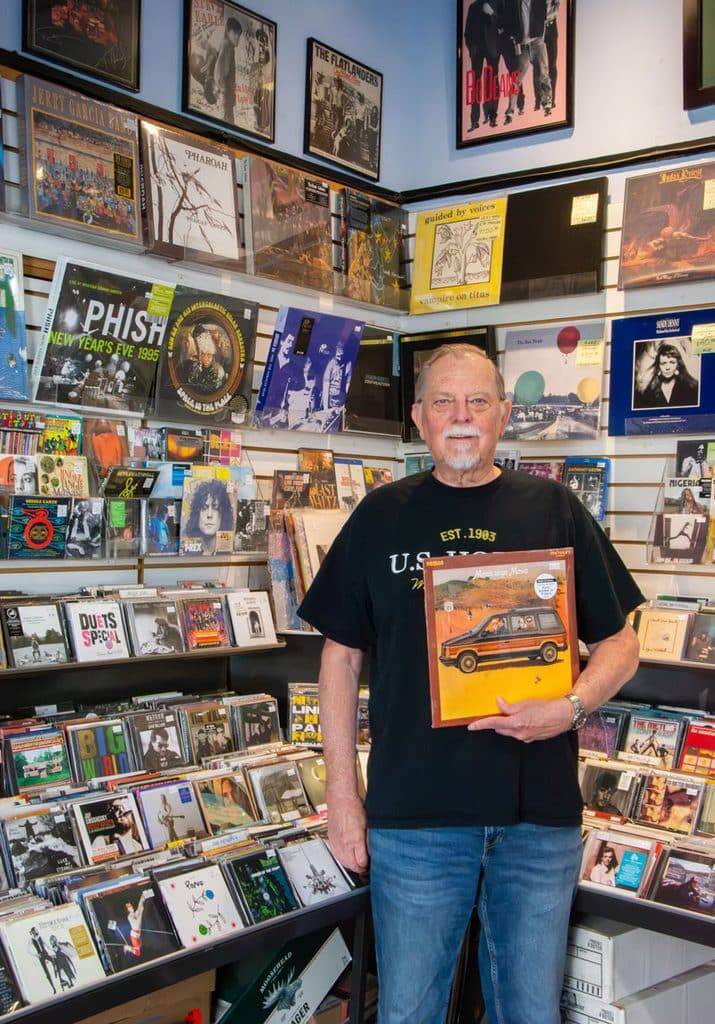
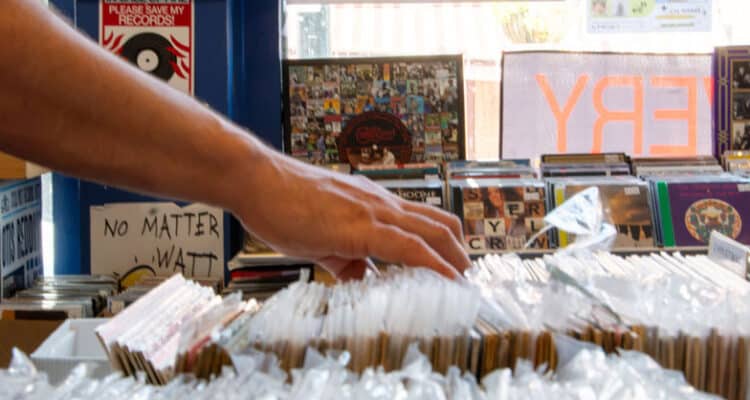
Main Street Music: The Search
For more than three decades, Main Street Music has been a place where finding something is part of the point. The retailer’s story is not simply about vinyl coming back. It is about what happens when music becomes something you can browse, discuss and discover with other people.
Pat Feeney opened Main Street Music in 1991. The shop began a few doors from its current location before moving to its current location in January 1997. After difficult years for the music industry, Pat says vinyl began bringing the business back in a meaningful way around 2010. Today, records account for roughly three-quarters to 80 percent of sales. CDs have recently begun attracting younger customers as well, including people discovering older artists through social media.
Jamie Blood, the store’s longtime manager, began working in record stores in high school and expected her job at Main Street Music to be temporary. Seventeen years later, she is still there, drawn in part by the opportunity to introduce people to something they might not have found on their own.
“You get to hold it in your hand,” Jamie says of physical music.
There is the artwork, liner notes and packaging, but also the ritual of putting a record on and turning it over when side A ends. A record can sit on a shelf for years before its cover catches your eye and brings back an album you had forgotten you loved.
Pat sees the staff’s role as a matter of trust. They are deliberately honest about recommendations, even when that means telling a customer not to buy something. Customers ask what Jamie and the other employees have been listening to or what they should hear next. Someone who likes one band might be pointed toward a lesser-known artist with a similar sound.
That knowledge becomes more specific with regular customers. The staff know their tastes well enough to anticipate what they might want when new releases arrive. Jamie compares the relationship to that of a bartender: a place where people know you and are interested in what you’ve been listening to.
One regular once called the store simply to say, “I’m enjoying myself so much. I just had to call and tell you.”
After 35 years, Main Street Music is more than a place to buy an album. It is a place where knowledge is accumulated, tastes are remembered and the next discovery might be sitting three rows deep in a bin.
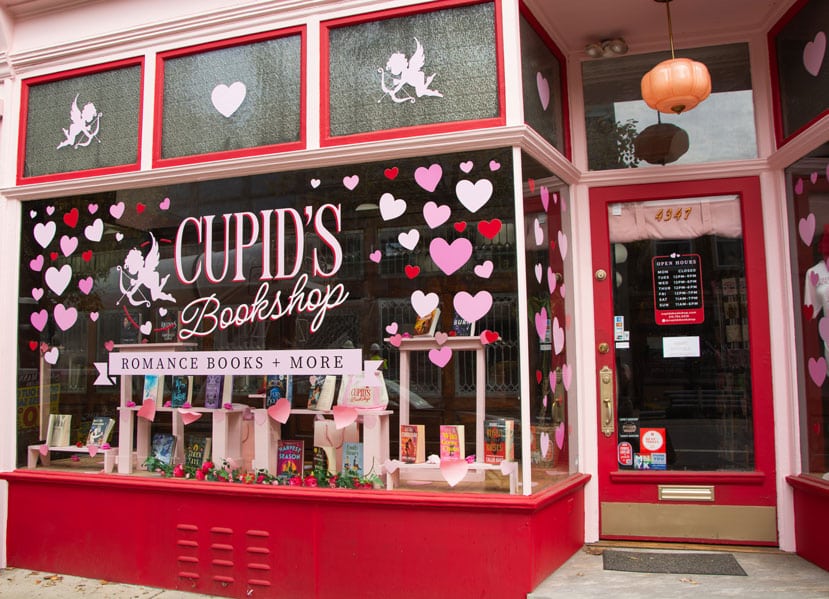
Cupid’s Bookshop: The Question
At Cupid’s Bookshop, the question isn’t always, “What book are you looking for?”
Sometimes it’s, “What do you like?”
Cupid’s is an all-romance bookstore and gift shop, but owner Tina Long built the store around the idea that romance isn’t one thing. There are contemporary romances, fantasy romances, paranormal romances, dark romances, cowboy romances, hockey romances and stories about people finding love again later in life.
The booksellers each have their own specialties, and their recommendations are shaped as much by conversation as by genre.
“Curating is kind of looking at what the locals like reading, what’s really popular in pop culture and then what we ourselves cannot stop talking about,” Tina says.
Tina’s personal shelves tend toward paranormal, dark romance and fantasy. Someone browsing traditional romantic comedies might leave with a recommendation about a vampire or werewolf instead. Another customer might simply be looking for a gift for someone whose reading habits they don’t quite understand.
The store has also become a place where people who don’t immediately see themselves as romance readers feel comfortable trying it. Tina remembers one local customer who initially insisted she only read nonfiction and literary fiction. A year and a half later, she was coming in almost every week, reading a romance novel a week and laughing with the staff about increasingly adventurous recommendations.
The customer didn’t need an algorithm to determine what she would like. She needed someone to talk to.
That human element extends beyond the books. Cupid’s carries candles, bookmarks, book sleeves and apparel that allow readers to extend a favorite story into their lives. Special editions might have sprayed edges or alternate covers that turn a book into something worth displaying.
“You want everything that’s involved with it,” Tina says.
Cupid’s also reflects something about Main Street itself. Tina describes the neighborhood as having a “whimsical” quality, a small-town feeling within a big city, and says that made it feel like the right place for a romance bookstore.
During the week, many customers are locals. They return to talk about what they read, what they loved and occasionally what they hated. Book clubs and craft nights give them another reason to stay.
“People want to hang out,” Tina says. “People need contact with each other.”
The books bring them through the door. The recommendation helps them discover something new. The conversation gives them a reason to come back.
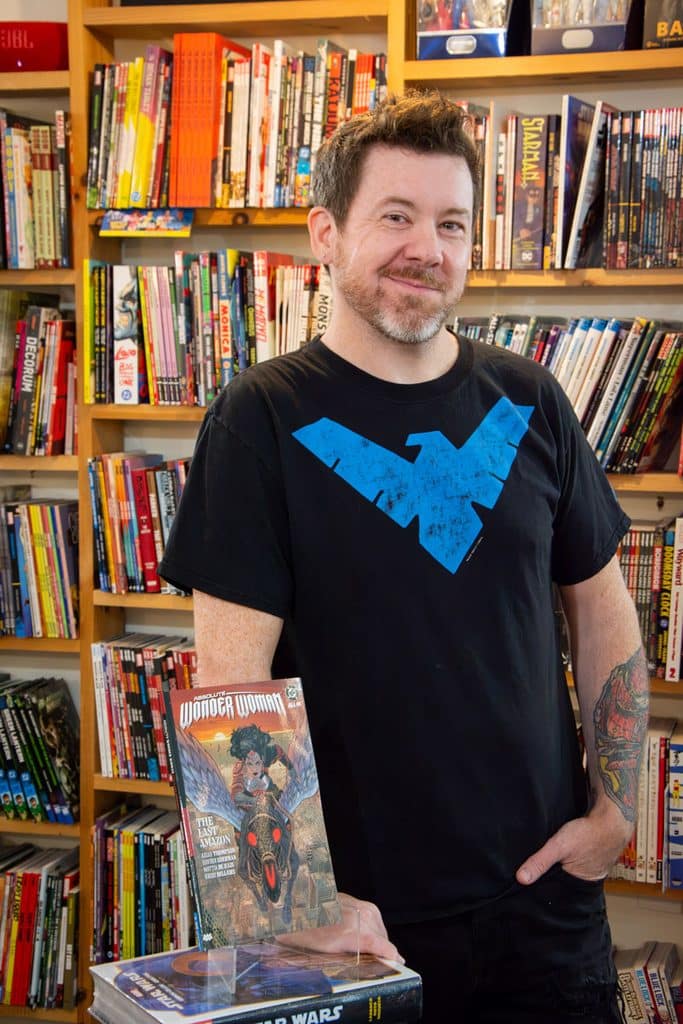
Johnny Destructo’s Hero Complex: The Welcome
For JD Holden, the owner of Johnny Destructo’s Hero Complex, the experience of a comic shop starts with making people feel welcome.
He remembers visiting a comic shop as a kid and encountering a clerk who was dismissive and judgmental. When he opened his own store in 2015, he knew he wanted to create a different kind of place.
Today, longtime comic readers share the space with people who have never been inside a comic shop. Some arrive thinking comics are mostly superheroes.
JD starts somewhere else.
What movies do you like? What television shows? What kinds of stories? What kinds of books?
Then he starts pulling things from the shelves: horror, crime, romance, graphic novels and queer comics. The recommendation becomes less about finding a particular comic than discovering that the medium contains something the customer didn’t realize was there.
“Half the fun of the gig is talking to people, and building a relationship,” he says.
JD doesn’t pretend every recommendation will work for everyone.
“It wasn’t for me. You might love it, but it wasn’t for me.”
His job isn’t to decide what someone should like. It is to know enough about the material, and enough about the person standing in front of him, to make a useful introduction.
The physical comic matters, too. Some customers prefer digital comics; others read digitally and eventually decide they want a physical copy anyway.
“I want to own it physically so I could have it on my shelf,” JD says.
The paper, artwork, lettering and sequence of images are all part of the experience. The finished book becomes something that can be returned to, displayed or shared.
But the story does not necessarily end when the comic leaves the shelf.
Johnny Destructo’s has a graphic novel book club, game nights, Drink and Draw, free-play games and a Discord community. A comic can be the reason someone walks through the door, but it can also become the beginning of a larger interest or a new group of friends.
For JD, that is ultimately the purpose of creating the store he wished existed when he was younger.
“It’s the people who feel like they don’t have a place to go and they find a place to go.”
The comic is physical. So is the community around it.
BreakBox: The Connection
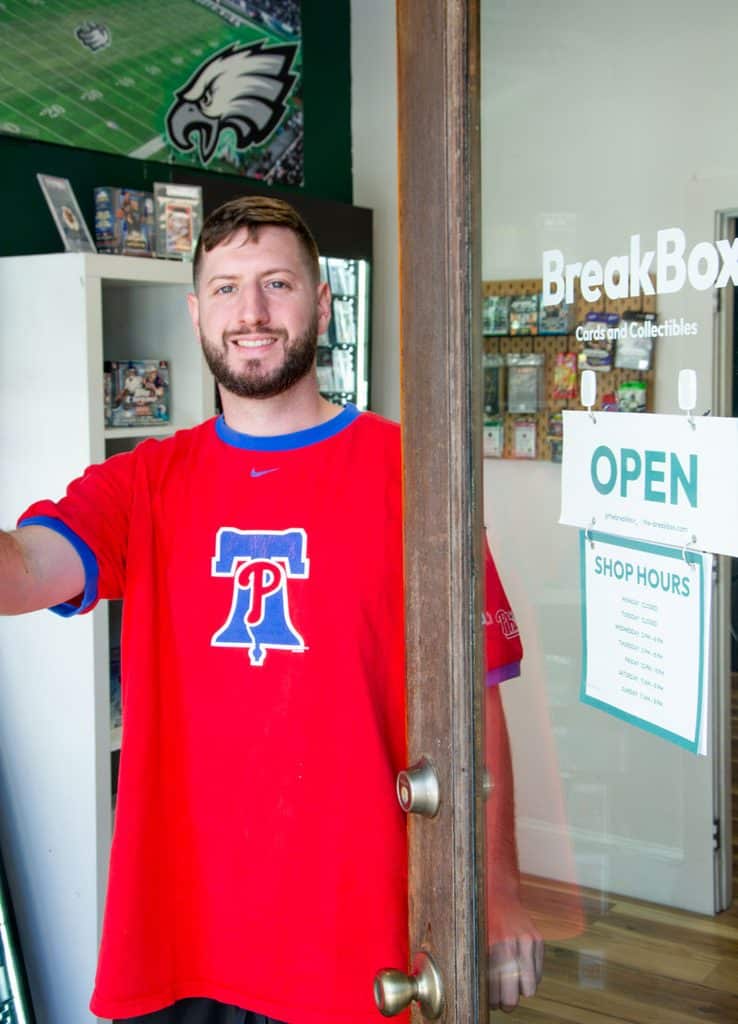
At BreakBox, the physical object is smaller still. Sometimes it is only a few inches of cardboard, but the stories attached to those cards can stretch back decades.
The people behind BreakBox, Mike Coyle, Pat Kerr and Mike’s father, Jack Coyle, are collectors themselves. Jack has been collecting for more than 50 years, beginning with cards given to him by uncles who were World War II veterans. Mike and Pat grew up opening packs while watching the NFL Draft or collecting Yu-Gi-Oh cards at the mall.
The store grew out of that history and recently opened its physical location in Manayunk, bringing together sports cards, Pokémon, Magic: The Gathering, Star Wars, Marvel, vintage cards and other collectibles.
The cards are objects, but they are also markers of memory: a player, a season, a childhood, a particular afternoon or the person who gave you your first pack.
That connection is part of what BreakBox is trying to recreate in the store. Mike, Pat and Jack talk about wanting something like the social experience of a barbershop, a place where you might come in for one reason, but stay because of the conversation. They call their version the “cardboard connection.”
At one of their first trade nights, the team was nervous that nobody would come. Instead, people showed up. Two children who didn’t attend the same school met through the event and by the end of the night asked whether they could be friends.
The cards were simply the excuse.
That same human element shapes how BreakBox approaches collecting. The hobby can be complicated, with different sets, inserts, parallels, variations and constantly changing products.
“Our job is to both see what somebody likes, but also educate them on the newness of the hobby,” Mike says.
A customer might love Star Wars. Another might collect baseball cards. Someone else might be looking for a gift for a child and have no idea where to begin.
One mother came into the store during an event looking for a gift for her son’s friend. She knew he liked baseball and had about $30 to spend. The staff assembled several possibilities and let the child choose.
This process is different from searching for “baseball cards under $30.” Online, the search begins with the product. At BreakBox, it can begin with the person.
“Trust is our most valued asset,” the owners say.
The card is what you take home. The connection is what brings you back.
Thrillerdephia: The World
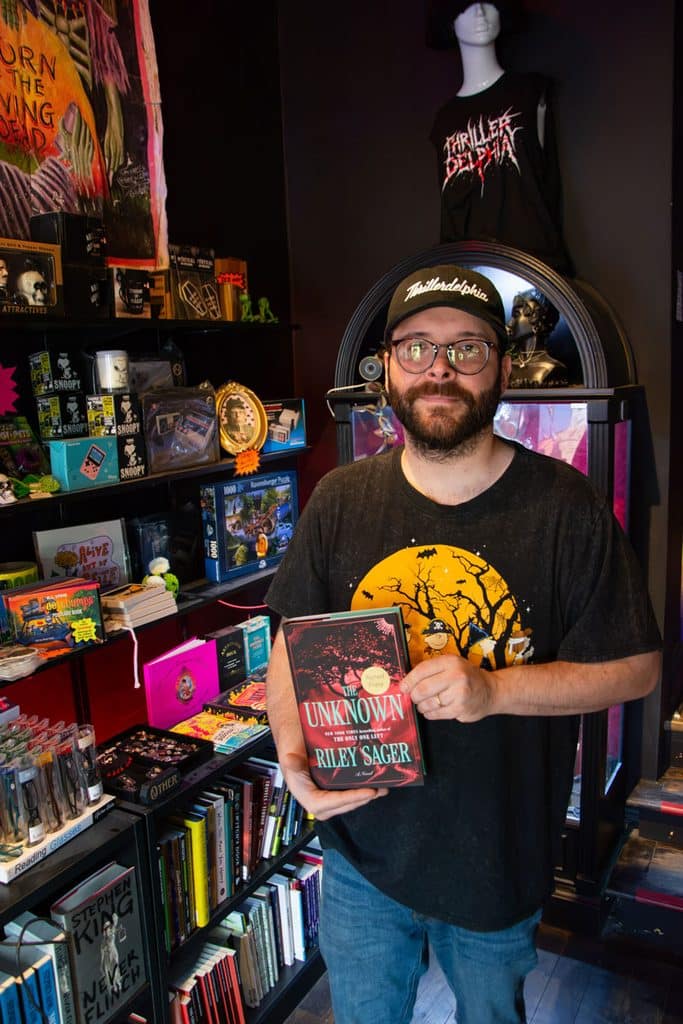
Thrillerdephia takes the idea of physical experience in another direction. The business describes itself as an “immersive bookstore,” built around horror and genre culture but extending into movies, music, vintage media and games.
The environment makes that clear before a customer reaches the shelves. A giant spider web, a life-sized skeleton, fog, lighting and displays turn the store itself into part of the experience.
“Sometimes the books are…the least interesting thing going on here,” says owner Anthony Long. “Not everybody comes in necessarily wanting a book. Sometimes they come in just wanting to see what’s going on.”
That philosophy extends to the store’s physical media. Alongside new and used books are DVDs, VHS tapes, vintage video games and other objects that have become increasingly difficult to encounter outside private collections. For Anthony, their value is partly in having something that is yours—something you can watch or play without depending entirely on what happens to be available digitally.
A customer might come looking for a book and leave with a movie. Someone browsing the VHS section might discover a film they have never heard of.
That is where curation becomes important.
Anthony describes himself as a “taste maker,” while the staff bring different areas of expertise: horror, thrillers, vampiric and occult material, music and other corners of genre culture.
With thousands of books and other media in the store, abundance can become its own problem.
“There’s people who are overwhelmed with options,” Anthony says. Sometimes the easiest way to narrow those options is to ask what a customer doesn’t like.
“It’s a lot easier to tell people what you don’t like.”
The store’s blind-date-with-a-book and blind-date-with-a-movie concepts make that uncertainty part of the fun. The title is hidden; the description becomes the invitation.
Events take the experience beyond the shelves. Authors appear alongside musicians. Horror fans can gather around a shared interest. People who arrive looking for a book can end up talking about movies, music, games or the broader culture surrounding them.
The object still matters. So does the person recommending it, the environment in which it is discovered and the people you meet along the way.
What Happens Around the Object
These five businesses sell very different things: a record, a romance novel, a comic, a trading card, a horror DVD. Yet walking between them on Main Street reveals an unexpected amount of overlap.
A record collector may also buy comics. A comic reader may collect cards. Someone who discovers a romance series at Cupid’s might come back for a book club. A visitor drawn into Thrillerdephia by a strange display might leave with a used book, or simply with a story about what they saw.
The businesses know one another, too. They refer customers, share audiences and participate in the same neighborhood.
People come to these stores to discover something, to get recommendations, to talk with someone who understands what they are interested in or to find other people who care about the same strange, specific things they do.
None of these businesses can compete with the internet on convenience or sheer volume. That isn’t really the point.
The internet is exceptionally good at helping us find exactly what we already know we want. These stores offer something different: the chance to find something we didn’t know we were looking for.
The items on the shelves may be what bring people through the door.
But in a world where almost anything can be found online, the real value of these stores may be everything, and everyone, you discover once you walk through it.