
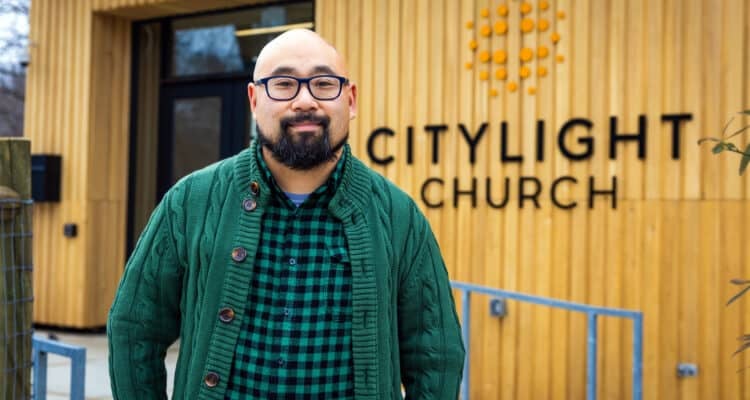
Inside the long journey to a permanent home for Citylight Church
By Ben Logue
Photography By Big T’s House of Photos
For more than a decade, Citylight Church lived in borrowed spaces. Founded in 2011, the congregation first gathered in living rooms before eventually settling into weekly worship at Mishkan Shalom synagogue up the hill. Sunday services required coordination, moving sound equipment, arranging chairs, setting up children’s areas, and then taking everything down again at day’s end. The rhythm built community, but it also reinforced a sense of impermanence.
Many members already lived nearby. Their routines, relationships, and daily lives were rooted in the neighborhood. When conversations began about finding a permanent home, the central question was not where to go, but how to stay.
That search eventually led to 4050 Main Street, a vacant industrial building, which was weathered, located in a floodplain, and in need of significant work. For church leaders and members, the decision to move forward combined practical planning with spiritual discernment.
“We weren’t trying to reinvent who we are,” Executive Pastor Jon Chin said. “We were trying to keep becoming who we felt called to be, right here.”
Staying in place
Remaining in the neighborhood mattered deeply to the congregation. Nearly half of its congregation already lived in Manayunk and Roxborough, and leaders saw permanence not as expansion but as commitment.
Visibility also played a role. After years in a less prominent location, a Main Street presence offered a way to participate more directly in everyday neighborhood life.
Church leaders describe the decision-making process as shaped by both faith and practical wisdom. Doors opened and closed on potential locations. Research addressed flood risks and structural concerns. Prayer accompanied each stage.
For Chin, faith did not remove difficulty but made it possible to move toward it. Trust and careful planning, he said, worked together rather than in opposition.
Imagining the space
Before renovation began, the building required imagination. Architectural plans helped translate possibility into reality, but prior experience also mattered. Worshiping for years in an older structure had already taught the congregation how historic spaces could become meaningful gathering places. Exposed beams, unfinished textures, and visible age were not obstacles but invitations.
Some design choices reflected that history— natural materials, reclaimed wood, and open structural elements carried a sense of continuity between past and present. Even so, compromises emerged, most notably the loss of usable ground-floor space because of flood risk. Once architects demonstrated what the upper level could become, the vision felt attainable.
Another defining feature was the setting itself. From parts of the building, visitors can look toward the river and the surrounding landscape, an uncommon experience in a dense urban corridor. Members describe the view as grounding—connecting worship to the natural world even within the city.

A long and uncertain process
Turning vision into reality required years of work marked by financial hurdles, construction delays, inspections, and coordination challenges.
Congregation-wide prayer accompanied practical problem-solving. Chin recalled moments when solutions arrived through unexpected timing, personal connections, or what members describe as provision beyond their planning.
Generosity also shaped the process. Volunteers contributed professional expertise, manual labor, and long hours. Contractors encountered groups of members arriving early in the morning to help move equipment or complete tasks that might otherwise have required outside crews.
The experience reshaped leadership as well. Delegation, collaboration, and recognizing the skills already present within the congregation became essential. Retired tradespeople, designers, artists, and organizers all played roles. The result, Chin says, is a building that reflects collective effort rather than individual direction.
Living with the river
The nearby river remains both backdrop and reality. Flooding is expected over time, and the renovation intentionally accounted for that risk through design decisions and material choices. Yet one conversation during a prayer meeting reframed the issue in a different way.
There was an older member, who has lived their entire lives in Manayunk, who had initially opposed buying in the floodplain, later described the eventual flood as an opportunity rather than only a threat. When water comes, he said, the congregation will return, clean the space, and help neighbors do the same, demonstrating faith through presence rather than avoidance.
For Chin, the comment shifted perspective. Mitigation remained necessary, but the flood itself became part of the church’s understanding of witness and responsibility within the neighborhood.
The Sound of Singing
When construction finally finished, and the congregation gathered to sing for the first time, something unexpected happened. The acoustics, unengineered, simply emerging from how old industrial bones met new finishing work, turned out to be extraordinary.
Voices rose toward the exposed rafters and came back down, blending in ways that made individual singers feel surrounded by the whole. People could hear each other in a way that transformed singing from performance into conversation. Some said it felt like being held inside a choir. Others said it might be what heaven sounds like.
Even the architect, returning for the opening service, stood amazed at what had been created.
Opening Day
The grand opening brought together years of planning, prayer, and labor in a single day. Former members returned. Community partners attended. Congregational singing filled the new sanctuary for the first time as one voice.
“I wouldn’t trade that day for anything,” says Walter Shaw, an associate pastor.
Yet the milestone quickly gave way to routine. Within days, the building hosted children’s programming that nearly relocated at the last minute because of construction timing. Everything came together within a narrow window, reinforcing for leaders how close the project remained to uncertainty until the very end.
The congregation moved through that opening week working 70-hour schedules, exhausted and grateful in equal measure, overwhelmed by the simple fact of arrival.

From temporary to everyday
As Citylight Church has settled in, the most significant changes have been ordinary. Children’s programs now have dedicated space. Youth groups meet regularly. A weekly grief-support gathering draws participants from beyond the congregation, including people with no previous church connection.
Small logistical differences carry emotional weight. Coffee no longer needs to be packed away each week. Chairs remain in place. Rooms are available for spontaneous gatherings or community use. These details mark the true transition from temporary meeting place to shared home.
The building has also created new opportunities for neighborhood engagement. Members now participate more easily in local events, from cheering runners during the marathon to offering refreshments at festivals, activities that previously required hauling supplies down the hill.
What permanence means
Church leaders describe the new building less as an achievement and more as a long-term promise.
They hope neighbors see stability in a corridor where businesses and institutions often change. Purchasing and renovating the property signals an intention to remain for decades, not just years.That commitment extends beyond Sunday services. Volunteer partnerships, service projects, and community programs that existed before the move now have a visible base of operations.
The building also connects present activity to neighborhood history. Preserved structural elements, historical references, and the surrounding industrial landscape remind visitors that the site belongs to a longer story, one the congregation now inherits and helps continue.
Building a church, not just a structure
For Chin and other leaders, the project ultimately clarified what it means to “build” a church.
Physical construction required planning, expertise, and sustained effort. Spiritual community requires trust, generosity, and shared purpose. The two developed together.
The visibility of the new space has already brought newcomers, some exploring faith for the first time, others reconnecting after years away. One recent attendee began their faith journey by asking spiritual questions. They discovered Citylight just as it opened, and were baptized within months.
Stories like that, Chin said, reinforce the congregation’s mission more than the building itself.
Looking forward
When asked what he hopes visitors experience upon entering, Chin answered simply: welcome, honest conversation, and an opportunity to encounter faith without pressure or pretense.
He also hopes the building communicates something broader about the neighborhood’s future. In a city where many former churches have become apartments or commercial spaces, an active congregation suggests that faith remains a present reality, not only a historical memory.
If the building could tell a story, Chin said, it would be one of endurance— people willing to remain, to serve neighbors, and even to face future floods with steady commitment.
Faith, in that vision, is not defined by certainty or permanence alone, but by the decision to keep showing up.
And on Main Street, after years of gathering elsewhere, showing up now has a place to begin.